| Professional biography |
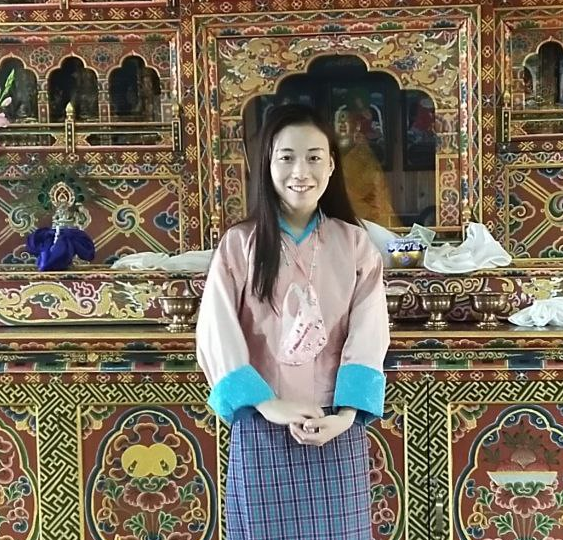
Deki Tshomo started working at Paro College of Education in September 2021. She completed her year 12 at Rangjung Central School in 2020. 

| Professional biography |
Deki Tshomo started working at Paro College of Education in September 2021. She completed her year 12 at Rangjung Central School in 2020.
| Professional biography |
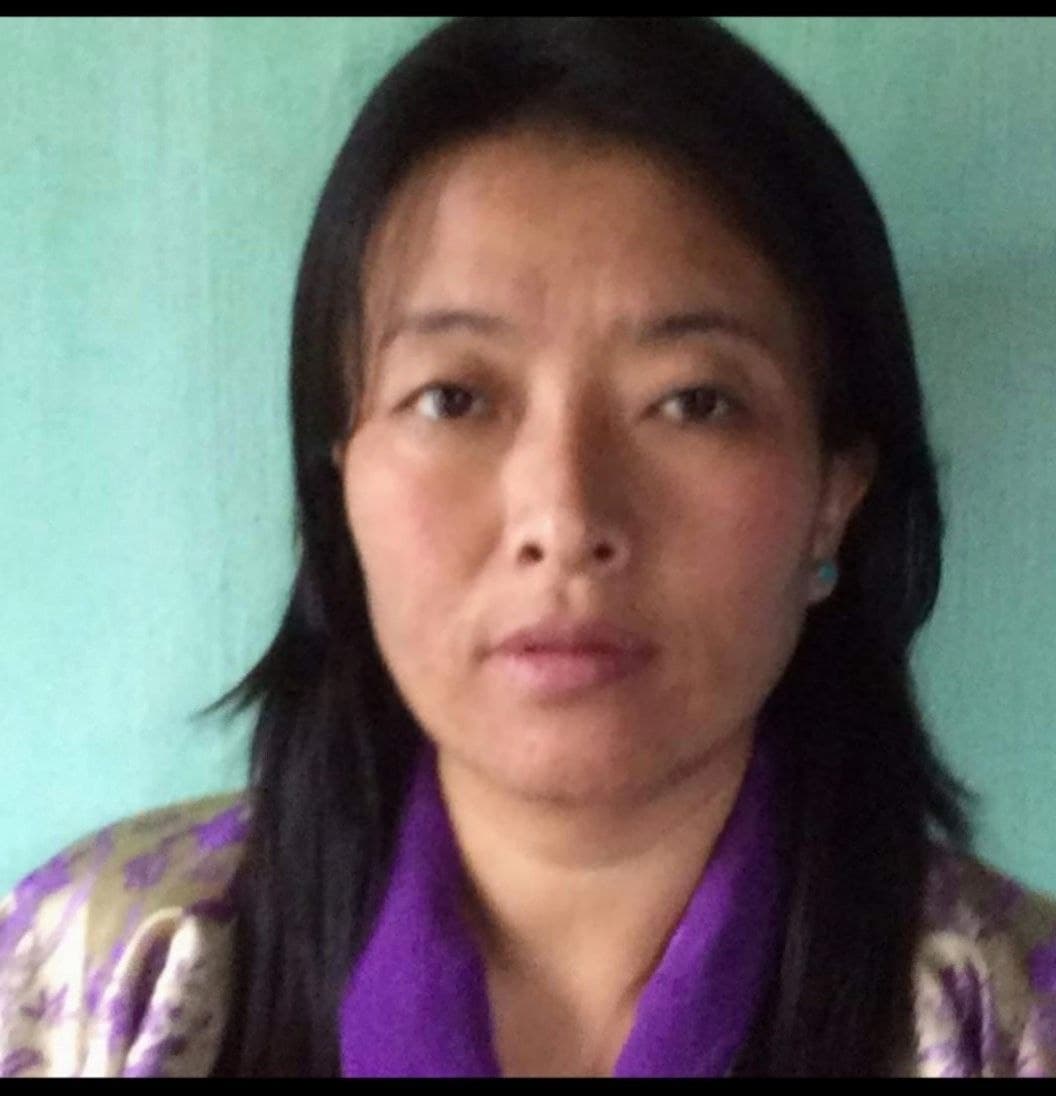 Tashi Wangmo is currently working as an Adjunct Lecturer at Paro College of Education. She teaches Creative Arts in the Lower Primary. She holds a Bachelor of Education (Primary B .Ed.) from Samtse College of Education. She was teaching Art Education in schools for eight years before joining the college. Her work experience includes reviewing the Art Education Teacher’s Manual and workbook; conducting SBIP and NBIP on Art Education for both teachers of government and private schools; Coordinator of, Art Club. Besides teaching, she initiated giving awareness in the community by recycling baskets and teaching weaving basket skills in the community. She also engaged the children every summer and winter vacation through art activities and the same was done during the lockdown too. As an art teacher, she conducted art competitions and also participated in all the open art competitions and won art prizes too. The greatest achievement was that she held the first ever grand SOLO Art and Craft Exhibition .She also published Class diary, school and Art and Craft Magazine and distributed it to the teachers of Bhutan during the Art Education workshop.
Email: tashiwangmo.pce@rub.edu.bt
| Professional biography |
 Mr. Tshering Wangdi is currently working as the laboratory Assistant at Paro College of Education. He has completed Diploma in Information Technology from Computer and Management Institute in the year 2010 and done two years certificate course in Computer Hardware and Networking from Rangjung Institute of Electrical Engineering in the year 2012. He has worked as an IT asst. officer at Eco Ventures Private Limited Como Uma Paro before joining Paro College of Education.
Email id: tsheringwangdi.pce@rub.edu.bt
PCE Library
Paro College Library System is powered by KOHA which is a full-featured open-source ILS.
Membership
All students, academic and administrative staff of the College are members of the library.
Teacher trainees are kindly requested to show their student ID while using library services.
Borrowing Access and Loan Periods
Overdue Material
Lost or Damaged Items
Holds & Recalls
Returns & Renewals
LIBRARY HOURS
YOUTH SKILLS & EDUCATION FOR EMPOWERMENT
A UNFPA-PCE Partnership Centre for Knowledge, Advocacy and Dialogues
Background
The UNFPA-PCE partnership began in 2009 with the introduction and promotion of Comprehensive Sexuality Education (CSE) through the Life Skills Education (LSE) Programme in Bhutanese schools. As part of the programme, schoolteachers were trained annually. With support from UNFPA, Paro College of Education has also provided this programme to its final year students each year since then. Further, the College has provided professional development training to faculty members, Heads of departments, Programme Leaders, Deans, Provosts, Student Leaders and College Presidents. The partnership also implemented a number of capacity building initiatives including research methodology workshops, national and international seminars, and research studies.
The College has also successfully published several books on CSE (e.g. Facilitator Manual 2010; CSE Handbook 2014; CSE Dzongkha Translation 2017; CSE Handbook 2019; Connecting Youth, Connecting Stories 2020; and Sexual Harassment Prevention Policy 2021). Beginning March 2020, as part of PCE’s strategic response to the onslaught of the COVID-19 pandemic, a number of initiatives were taken to enhance emotional and psychological resilience among the youth. Accordingly, the College successfully conducted online activities such as stories related to the pandemic, workshops for final year students and psychological outreach programmes to the community.
In order to consolidate and sustain the partnership programmes and initiatives of the past twelve years and to provide future direction for youth skills and education for empowerment, a Centre has been established and launched on 25 November 2021. Inaugurated by Her Majesty Gyalyum Sangay Choden Wangchuck, the UNFPA-PCE Partnership Centre for Knowledge, Advocacy and Dialogues will anchor all UNFPA supported activities on UNFPA’s and RUB’s developmental goals and priorities so that these efforts continue to have positive impact on Bhutanese society. Accordingly, the Centre will reach out to schools, youth population in Bhutan and the wider community to support them through knowledge, advocacy and dialogues related to mental health, sexual and reproductive health rights, gender based violence, and other developmental issues.
Vision
To generate knowledge, advocacy and dialogues on mental health, sexual and reproductive health rights, gender based violence, and other developmental issues in society.
Mission
The UNFPA-PCE Partnership Centre shall strive to:
Nangkhar Choeling Learning Center
Background
Established as educational innovation, Nangka Choeling Learning Centre (NCLC), located in the student residential area, is designed to provide the physical and psychological conditions for students to cultivate sustained reading habits, intellectual curiosity and lifelong learning. The creative learning space was officially launched on 22nd February 2021 by former Tsugla Lopon, Samten Dorji.
The centre is a space where students have access to books, with zero cost as the books have been donated by various personnel who visited the centre. A well-read teacher can inspire students to cultivate lifelong reading habits and keep their minds open, wide and spacious. It is based on the belief that a community of knowledgeable teachers can help build learning schools that in turn will help to build a thinking nation, thereby creating a knowledge society.
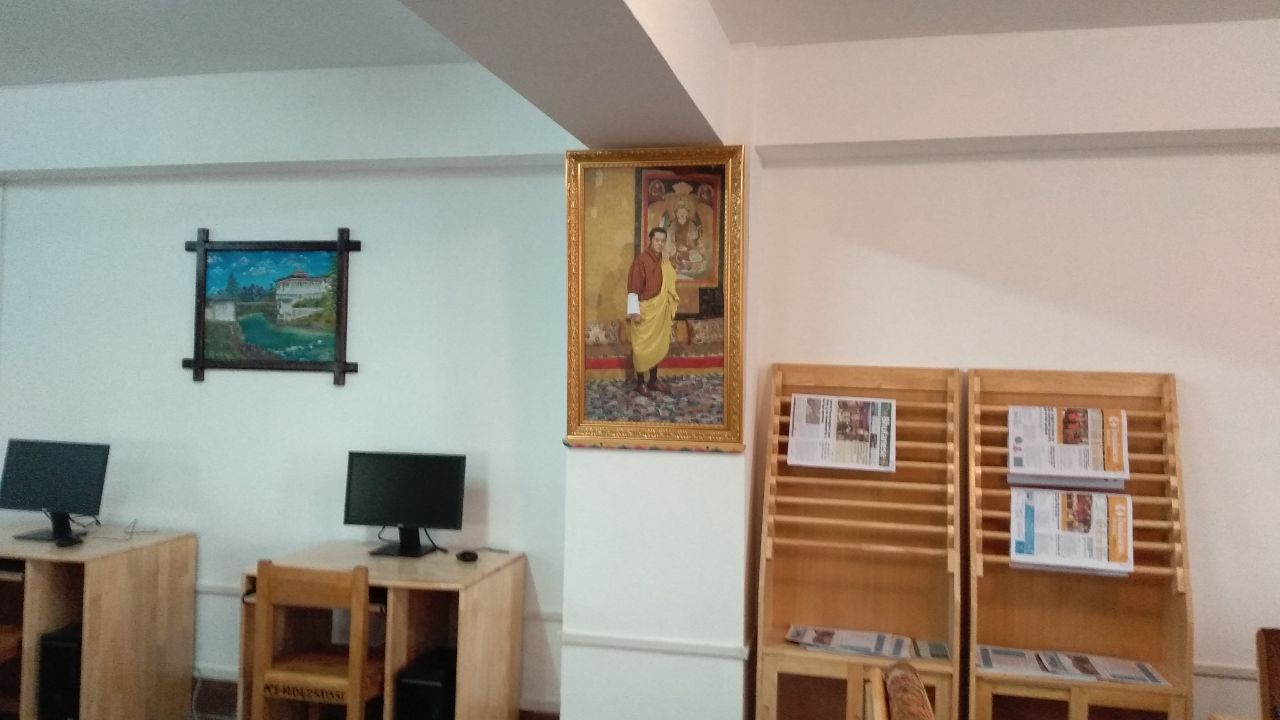
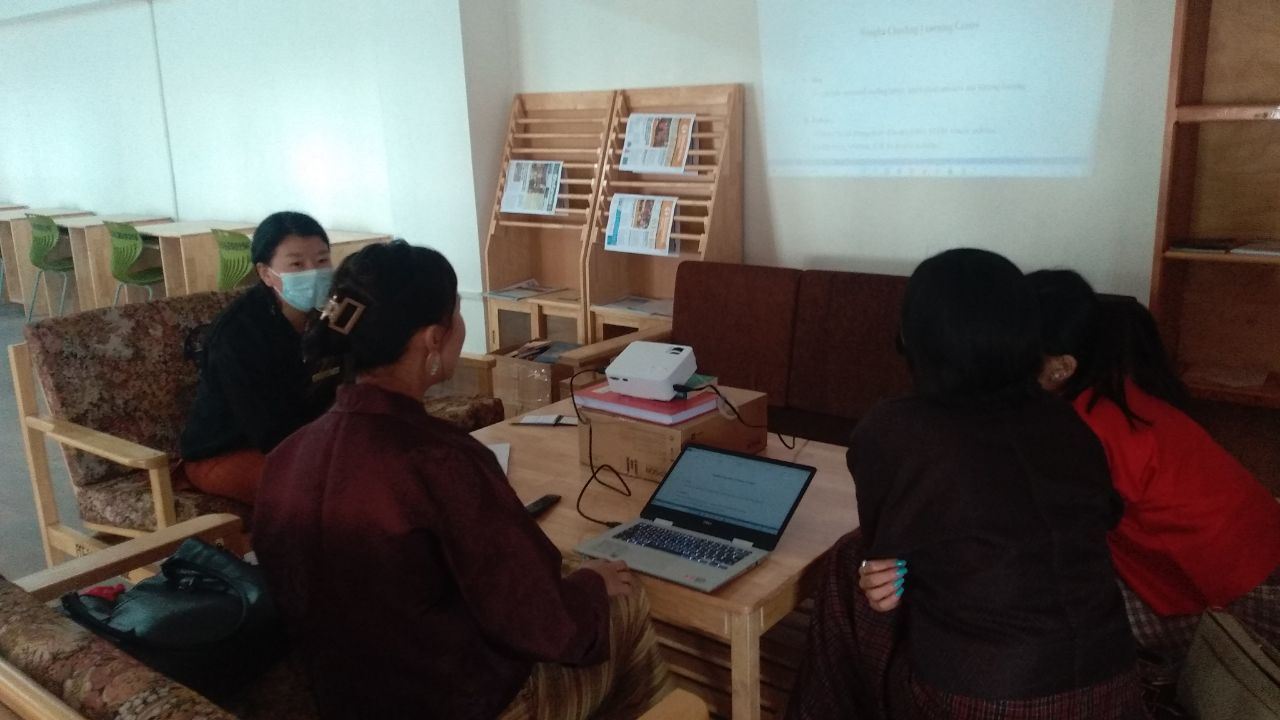
This creative space provides students the accessibility to resources that will aid in their learning and personal development. The students have access to facilities such as computers and projector with Wi-Fi access. The learning space creates a conducive environment for students to carry out group discussions and presentation preparations.
With the establishment of Nangka Choeling Learning Centre, it has added tremendous benefits for the students in terms of overall personal and academic well-being. Some of the salient features of the centre are;
Happiness and Wellbeing Center
Background
The Happiness and Wellbeing Centres was established in 2019 to address the emerging wellbeing, academic and career challenges at RUB colleges. The centre is supporting Paro college in fulfilling the overall vision to become ‘An internationally recognized university steeped in GNH values’. The centre was established with financial assistance from the European Union, Erasmus Plus Programme through a project developed and coordinated by Paro College of Education in partnership with three Universities from European Union: VUB, Brussels, ISMAI, Portugal, and UoB, UK.
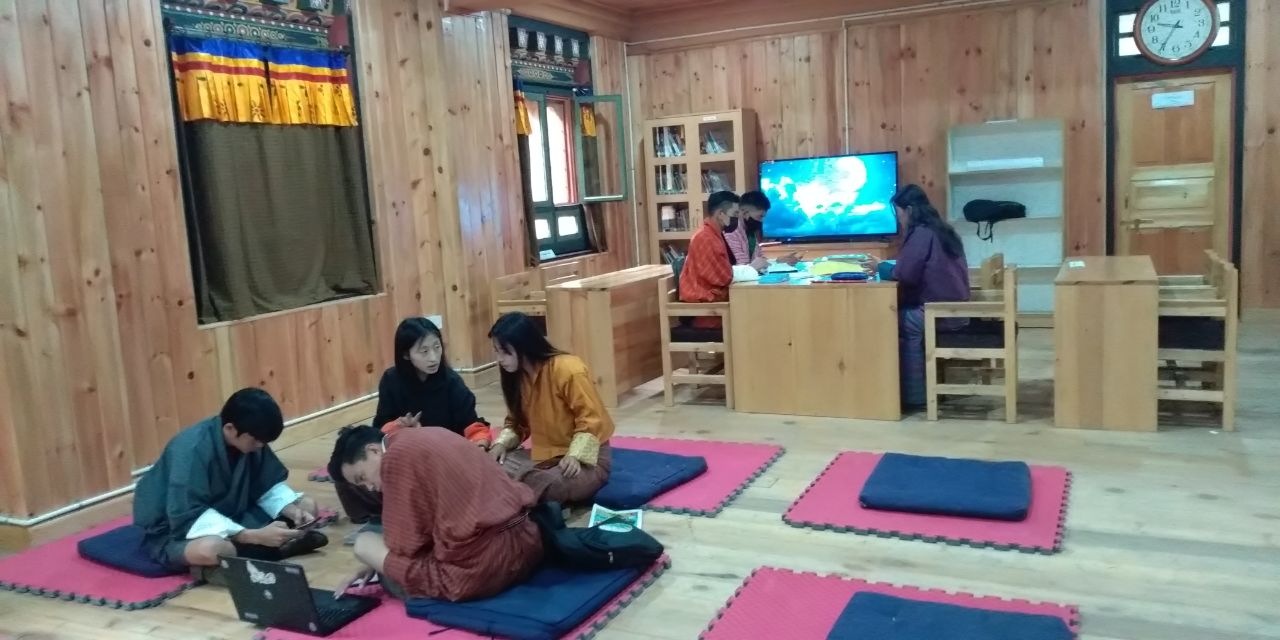
The Happiness and Wellbeing Centre is serving as a safe place for the students of the Paro College to seek refuge, and it provides opportunities for the interested students to build skills, enhance insight, and grow resilience, which will all go a long way in preparing them for life. The happiness and wellbeing centre lead in counselling & wellbeing education, training, and research programmes. The centre also cater services related with happiness, wellbeing, and counselling to PCE staff, local community, government agencies, and Non Governmental Organizations. Some of the services that the centre caters are mindfulness, one-to-one counselling, group counselling, courses on insight, and skill enhancement. The centre also initiate tailor made group courses on need-based themes such as ‘Being Bhutanese’ ‘Leadership of Self’ & ‘Working with life challenges’ etc. The centre is manned by three trained professionals under the office of Dean of Student Affairs.
The physical space of the centre is divided into six main corners. The students can use the lounge outside for group discussions, and coffee moments to surf the net or charge their gadgets, the inner space is divided into three sections: 1) the mini stage that can be used to enhance their communication, or presentation or social skills 2) the carpeted floor with fifteen mats is used for regular mindfulness sessions 3) the sitting arrangement next to the book cardboard is used as a mini library and educational screen viewing. The students use the separate room fitting with six computers and a heavy duty printer for academic and career related activities. Finally, the room deep inside the centre is used for one to one counselling sessions.
| Master of Primary Mathematics (2 years -Full Time) |
General Aims
The programme is intended to provide a holistic learning experience to primary mathematics teachers. The programme aims to offer a rich training ground and experiences for practicing mathematics teachers to enhance their existing pedagogical knowledge and skills. In the process, produce the next generation of teachers sufficiently prepared to teach primary mathematics with creativity, enthusiasm and passion. Therefore, the programme will prepare students with new approaches and strategies for presenting mathematical concepts in relevant, engaging and meaningful ways.
The programme is focused on the enhancement of domain knowledge, educational foundations and research skills. These are intended to raise teachers’ knowledge and competency levels. Consequently, they can help improve the quality of children’s experience with mathematics. Further, it is designed to ensure that students understand the current theories and practices in the pedagogy of primary mathematics. The research component of the programme will develop their ability to implement evidence-based approaches and strategies to address the needs of students.
The outcome will be the development of students who could be accomplished and distinguished in teaching of mathematics (BPST, 2020). Further, they will be able to offer critical perspectives on the primary mathematics curriculum. At the same time, initiate change in classroom practices, provide academic leadership in school, and help build a professional community of mathematics teachers. Thus, these aims align with the standards and expectations laid out for teachers in the Bhutan Professional Standards of Teachers, which seeks to achieve high levels of professional competency for teachers in Bhutan.
Objectives
Upon completion of the programme, graduates will be able to:
Programme Structure
| Year | Semester | Modules | |||
| 1 | I | MTA505
Principles and Standards for School Mathematics |
MTA506
Mathematics Teaching and Classroom Practices |
PSY505
Understanding Learners and Learning |
RES506 Educational Research Methods |
| II | EDT504
Digital Pedagogy |
MTA507
Educational Statistics |
MTA508
Representation as a Learning Strategy in Mathematics |
RES507 Educational Research Project | |
| 2 | I | MTA609
Equity Issues in Discourse for Mathematics Education |
MTA610
Teaching Numbers and Operations in Primary Mathematics |
ASE604
Educational Assessment |
|
| II | MTA611 Problem Solving in Primary Mathematics | MTA612
Differentiating Instruction in Mathematics |
CUR607 Curriculum Development and Implementation | MTA613
Misconception in Primary Mathematics |
|
Admission Criteria
Prospective candidates should fulfill the following criteria.
For Inquiries , you may contact:Mr. Tshewang Tobgay Mr. Karma Yeshey Programme Leader Dean of Academic Affairs B.Ed Primary Email: karmayeshey.pce@rub.edu.bt Email: tshewangtobgay.pce@rub.edu.bt Phone # +975-8-271620 Phone # +975-8-271487 Fee Structure Inquires about tuition fees may be directed to sangaychoden.pce@rub.edu.bt at phone number +975-8-271497 |
| Master of Primary Social Studies (2 years -Full Time) |
General Aims
The programme will provide a holistic learning experience in Social Studies focused on the enhancement of domain knowledge, pedagogy, curriculum and assessment practices, as well as interdisciplinary connections to related fields. Accordingly, the programme will provide learning experiences combined with research skills that will equip students with the ability to implement evidence-based approaches and strategies to address the needs of students. As a result of their advanced studies in the teaching of Primary Social Studies, they will be able to offer critical perspectives on the primary Social Studies curriculum, initiate change in classroom practices, provide academic leadership in school, and help build a professional community of teachers committed to enhancing the policy and practice of primary education.
These aims align with the mandate of the Bhutan Professional Standards of Teachers and the Tertiary Education Roadmap of Bhutan which seeks to achieve high levels of professional competencies to create a teaching community of highly knowledgeable, and reflective practitioners based on the unique Bhutanese values of tha dam-tshig ley gju-drey and philosophies of child centeredness, inclusivity and lifelong learning (Ministry of Education, p.7, 2019).
Through this programme, teachers will be able to help their students to develop abilities to make informed and reasoned decisions for benefit and wellbeing as citizens of a spiritually and culturally diverse, democratic society in the fast-developing world. Students can study people in relation to each other and to their world, as an issue-focused and inquiry-based interdisciplinary subject that draws upon history, geography, ecology, economics, sociology, anthropology, philosophy, political science and other social science disciplines. It will also provide students the opportunities for a wide range of ideas/concepts to cope with the surroundings through engagement in scientific, economic, historic and geographical processes. Students will be able to develop skills in learners by involving them in investigation, experimentation, survey, observation, measurement, interpretation and communication culminating a valued social knowledge of today and tomorrow. Besides, it will help them to shape every learner to be socially responsible and productive citizens.
Objectives
Upon completion of the programme, graduates will be able to:
Programme Structure
| Year | Semester | Modules | |||
| I | I | SSA503 Place-Based Education in Social Studies | SSA504
Making Sense of History in Social Studies |
PSY505 Understanding Learners and Learning | RES506 Educational Research Methods |
| II | EDT504
Digital Pedagogy |
SSA505 Addressing Social Issues in Social Studies | SSA506
Making Sense of People, Places and Environment |
RES507 Educational Research Project | |
| II | I | SSA607 Understanding Social Values and Culture | SSA608 Thinking Skills through Social Studies Disciplines | ASE604 Educational Assessment | |
| II | SSA609 Social Change and Development in Social Studies | SSA610 Individuals, Groups and Institutions in Social Studies | CUR607 Curriculum Development and Implementation | SSA611 Living and Economy | |
Admission Criteria
Prospective candidates should fulfill the following criteria.
For Inquiries , you may contact:Ms. Dechen Tshomo Mr. Karma Yeshey Programme Leader Dean of Academic Affairs M.Ed Primary English Email: karmayeshey.pce@rub.edu.bt Email: dechentshomo.pce@rub.edu.bt Phone # +975-8-271620 Phone # +975-8-271487 Fee Structure Inquires about tuition fees may be directed to sangaychoden.pce@rub.edu.bt at phone number +975-8-271497 |