

 When the posters for Talent Space appeared all over the campus- on walls, pillars, notice boards, and everywhere…I couldn’t help but ask my friends Sangay and Pema Chenzom about it during a casual gathering at Sangay’s place.
“Talent Space? What’s that?” I asked.
Pema shrugged. “I think it’s a talent show. Something where we can showcase anything, literally any performance, any skill.”
Immediately, my mind started racing. “We should try! We could do a skit or dramatization. We literally just did Theatre-Based Training, and it’ll be a plus point for us.”
Sangay’s eyes sparkled. “We can, Dekhar! Let’s form a team and participate. I already have a story in mind- Helen Keller’s Story. It would be meaningful to present her journey.”
Pema and I agreed without hesitation. But then came the first challenge; we needed someone to play the father.
“Ask Panda,” I suggested. “He can take any role, and he facilitated our theatre training anyway.”
Before I could finish, Pema had already reached out. He agreed immediately. With the team formed and a script drafted, everything felt possible. Or so we thought.
Reality, however, had other plans. Conflicting schedules, personal commitments, and delays became our constant challenge. There were days when Pema and I waited endlessly for the others to show up, calling multiple times with no response. Frustration built up to the point where we even whispered to each other:
“Maybe withdrawing is better than embarrassing ourselves.”
And yet, the next day, all four of us gathered. Perhaps it was fate. Perhaps stubbornness. Whatever it was, we decided to give it a go. One final try. Not giving up. Not today!
Our rehearsal went well, and we received compliments. But one suggestion stood out: include a narrator for better flow. Sangay invited his friend Dorji, and our team became five. With renewed energy, we resumed preparation.
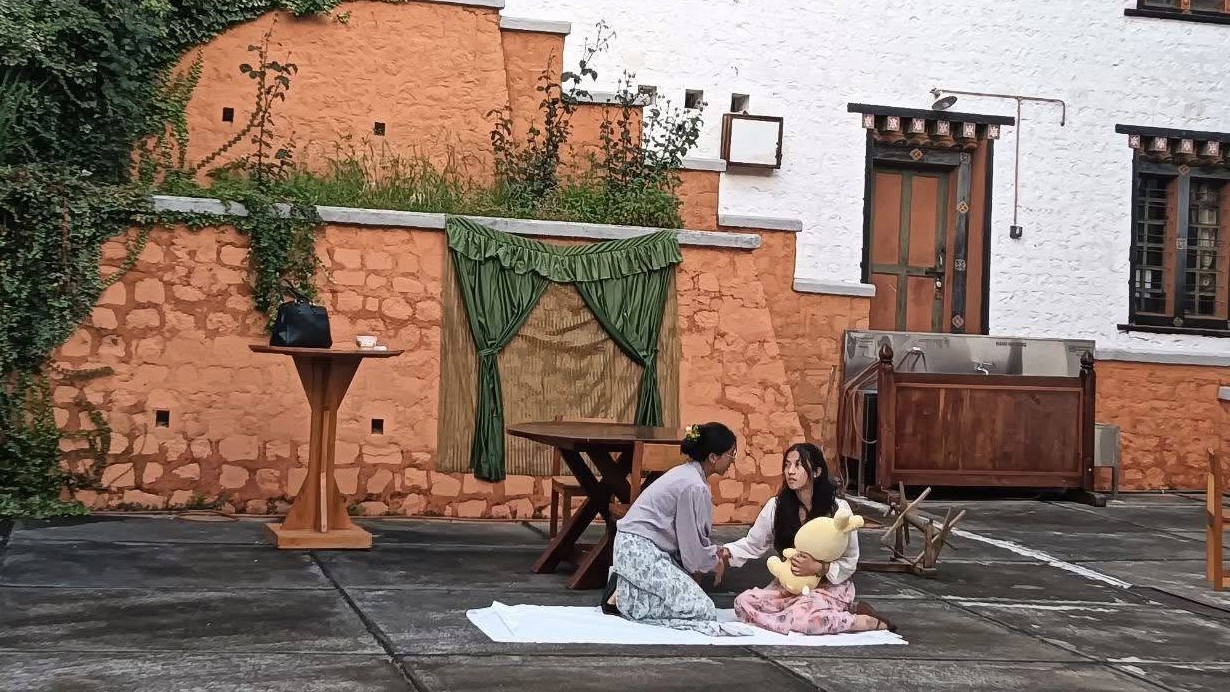
Unlike traditional talent shows in a hall, Talent Space allowed each group to select a location on campus for performance. We chose the space in front of Manjushree Hall and the Staff Room which was spacious, green, and with a water source that added realism to our scenes.
Other teams were highly polished, confident, and prepared. For a moment, I wondered if our skills alone would suffice. We realized that preparation, not just talent, would determine the outcome.
On 10th September, after classes, we set up our stage. And then… the sky betrayed us. Heavy rain poured down, soaking our props, the stage, and us. We rushed to protect what we could, waited anxiously for the rain to stop, and reset everything once the weather cleared. With limited microphones and being the last group to perform, the situation was tense. Yet, we held on to a simple hope: everything will go fine.
When it was finally our turn, we performed with full dedication. The audience’s response was overwhelming: a standing ovation, tears, smiles, and pride. Even without microphones, our natural voices added depth to the story, making it soulful and authentic. The organizer concluded, “And with this, we got the talent!!”
We later received an invitation to perform again during Disability Week, organized by the Inclusive Education Department in college. For a group that struggled, almost gave up, and faced so many challenges, this opportunity felt extraordinary.
Experiences like Talent Space are more than just competitions; they are platforms that profoundly shape the lives of trainees at Paro College of Education. Participating in such initiatives nurtures confidence, creativity, and collaboration. It teaches problem-solving in real-time, resilience in the face of setbacks, and the value of persistence.
For teacher trainees, these activities are particularly impactful. They offer opportunities to step beyond academic learning and classroom theory, applying skills such as communication, teamwork, and leadership in practice. The challenges we faced- scheduling conflicts, unexpected rain, stage logistics and many more mirrored real-life obstacles we may encounter as future educators. Navigating them built patience, adaptability, and a sense of accomplishment that is difficult to achieve through coursework alone.
Additionally, these initiatives foster inclusivity and awareness. Presenting the story of Helen Keller allowed us to reflect on the experiences of individuals with disabilities, aligning with the college’s mission to cultivate socially conscious educators. By encouraging participation in diverse activities, Paro College of Education creates spaces where trainees can explore personal interests, develop talents, and gain confidence to express themselves- all while building a supportive community.
The Talent Space results are yet to be announced, and the winner remains unknown. But for us, the victory was never just about winning. It was about perseverance, teamwork, and growth. It was about a group of trainees who almost gave up but chose to try one last time, and ended up creating something meaningful and memorable.
At Paro College of Education, initiatives like Talent Space demonstrates that learning extends far beyond lectures and assignments. They prepare trainees not only as educators but as confident, resilient, and creative individuals ready to contribute to society. And for us, the true success lies in knowing we did it, all TOGETHER!
Just like how we concluded the drama, I want to conclude this article with “Everyone has the Rights to Learn, we just need to SEE it.”